



GLP-1 weight-loss drugs have crossed a line that looked hard to imagine only a few years ago.
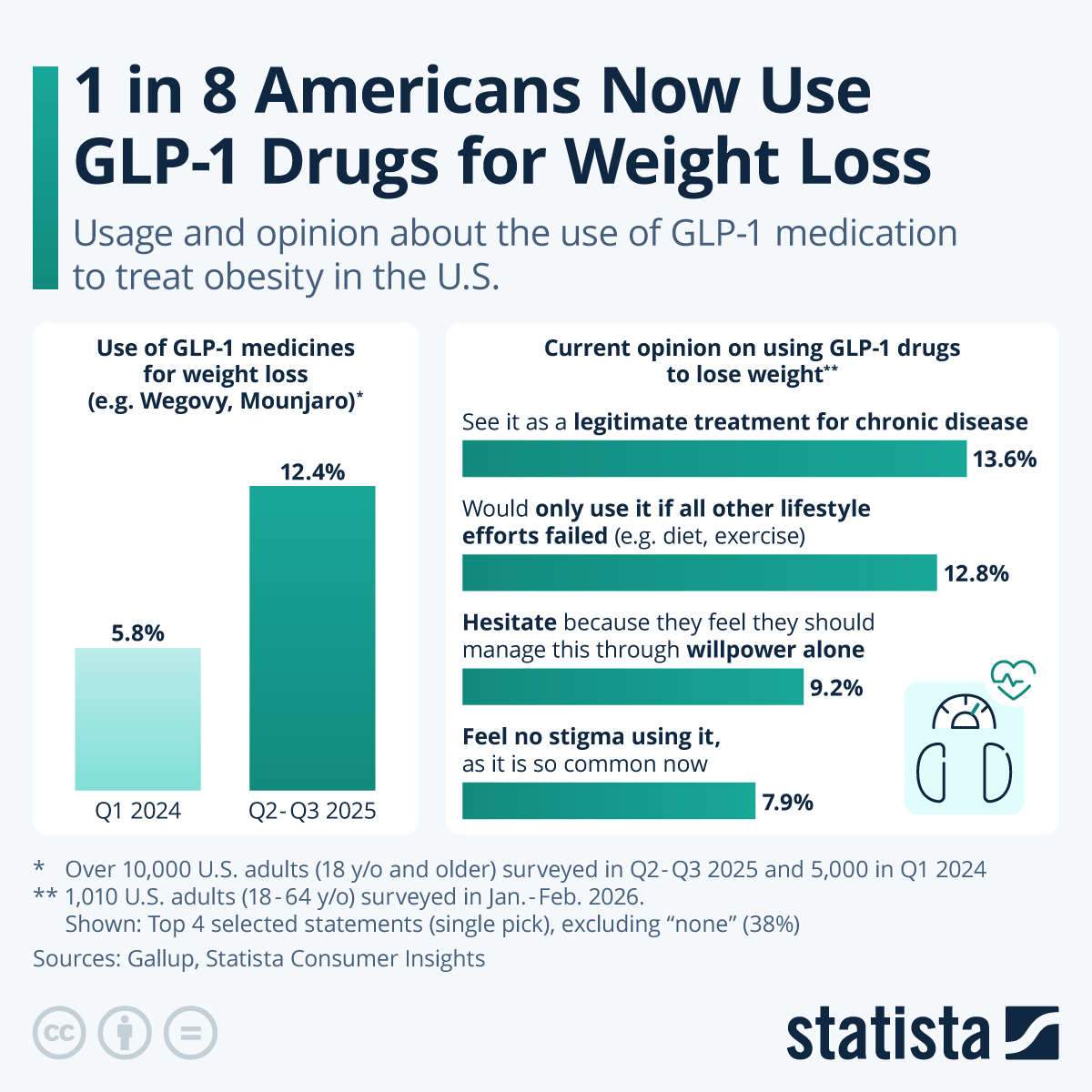
According to Gallup, about 11% of U.S. adults now say they take one for weight loss, compared with just 3% in 2024.
Based on the adult population, that works out to roughly 28 million Americans. Another 15% say they have used one at some point, compared with 6% two years earlier.
Awareness has climbed almost as quickly. About 90% of Americans now know about GLP-1 weight-loss drugs, compared with 80% in 2024.
A jump that large in two years is not just a strong sales story. It signals a change in how Americans think about weight treatment. Medication that recently felt novel, expensive, and slightly experimental is becoming part of ordinary conversations about obesity, primary care, insurance, and long-term health.
Anyone still treating GLP-1s as a niche wellness fad is looking at an older version of the market.
Why Use Is Rising So Quickly
 Newer medications helped open the door.
Wegovy received approval for chronic weight management in 2021, followed by Zepbound in 2023.
Insurance coverage for branded GLP-1 drugs can be inconsistent, and out-of-pocket prices can put them well outside many household budgets.
Cheaper compounded versions have become one way patients try to get around that barrier.
Among current users, 66% say they take a brand-name GLP-1, 18% use a compounded version, and 13% are not sure which type they take.
Switching patterns are even more revealing:
- About 36% of compounded-drug users previously took a brand-name medication.
- Only 11% report moving in the opposite direction.
Among people who switched away from a brand-name drug and toward a compounded option, 53% cite cost or insurance as their main reason.
That detail matters because it helps explain why use can rise even while list prices still look intimidating. Patients did not wake up one morning to discover cheap branded GLP-1s.
Access routes expanded, telehealth became more common, compounding grew, and consumers got better at finding alternatives.
Popularity, in other words, is not only about medical demand. It is also about people finding a path around a price problem.
Results Look Encouraging, but Overselling Them Would Be a Mistake

About 74% of brand-name users and 80% of compounded users rate their medication as effective or extremely effective.
Those numbers sound impressive, but they need the right interpretation. Patient ratings tell us how people feel about their results. They do not prove that compounded products outperform approved brand-name drugs in a controlled clinical comparison.
National obesity data add another interesting piece. Self-reported adult obesity has fallen to 36.8% in 2026 after reaching a record 39.9% in 2022.
Reported diabetes prevalence now sits at 12.8%, dipping below 13% for the first time since 2022.
Timing makes the pattern hard to ignore. GLP-1 use has surged while reported obesity has declined.
Still, a national survey cannot prove that GLP-1 drugs caused the entire drop.
Plenty of other factors can move obesity statistics, including changes in diet, physical activity, diagnosis, demographics, survey behavior, and access to care.
So what can we say confidently? A major new class of weight-loss medication is being used by millions more people at the same time that reported obesity is moving lower. That is a meaningful signal.
Saying GLP-1s are single-handedly solving obesity would go much further than the evidence allows.
Their Popularity Is Already Changing Obesity Medicine

Medication is also changing what happens inside weight-loss clinics.
Las Vegas bariatric surgeon Dr. Bernie Hanna says his surgical volume has fallen about 50% as more patients turn to GLP-1 drugs. He has also pointed to bariatric practices closing as demand shifts.
The drop suggests medication is replacing or delaying procedures that once looked like the main medical option for some patients with obesity.
That does not mean bariatric surgery is disappearing. Surgery can still produce major and durable weight loss, and some patients are still better candidates for an operation than medication.
Still, patient behavior is clearly changing. Faced with an injection and a surgical procedure, many people will at least try the medication first if they can access it.
Another issue deserves more attention as that happens: weight loss is not automatically the same thing as better body composition.
Hanna has warned that patients can lose muscle along with fat.
Adequate protein, regular exercise, and resistance training can matter during treatment, especially when weight comes off quickly.
More Users Mean More Attention on Risks
Rapid growth also changes how safety gets discussed.
Common side effects can include:
- Nausea
- Vomiting
- Constipation
- Diarrhea
- Slowed stomach emptying
Pancreatitis is among the more serious potential complications physicians watch for.
Manufacturers also face hundreds of lawsuits alleging severe stomach problems and vision loss. Allegations deserve scrutiny, but a lawsuit does not establish that a GLP-1 drug caused every reported injury.
Severe complications appear to be uncommon, which is important context.
Still, uncommon problems become much easier to notice once tens of millions of people are exposed to the same drug class.
Compounded products create a separate concern. Unlike approved branded medications, compounded GLP-1 drugs do not go through premarket review for safety and effectiveness before reaching patients.
That distinction can disappear online, where brand names, active ingredients, telehealth offers, and compounded products often get discussed as if they were interchangeable.
For consumers, that is probably one of the most practical points in the entire GLP-1 debate.
Knowing exactly what product you are taking, who prepared it, how it was prescribed, and what medical follow-up you are getting matters.
More use does not automatically mean more danger. More use does mean safety questions deserve more serious attention.
Closing Thoughts
At 11% of American adults, GLP-1 weight-loss drugs are no longer waiting to catch on.
They are already reshaping patient choices, insurance battles, obesity treatment, and parts of the weight-loss medical business.
Long-term adherence is another problem. Side effects, muscle loss, nutrition, and medical oversight become more important as treatment spreads across a much larger population.
GLP-1s have entered mainstream medicine. The next phase will be harder because success will depend on more than a falling number on the scale.