


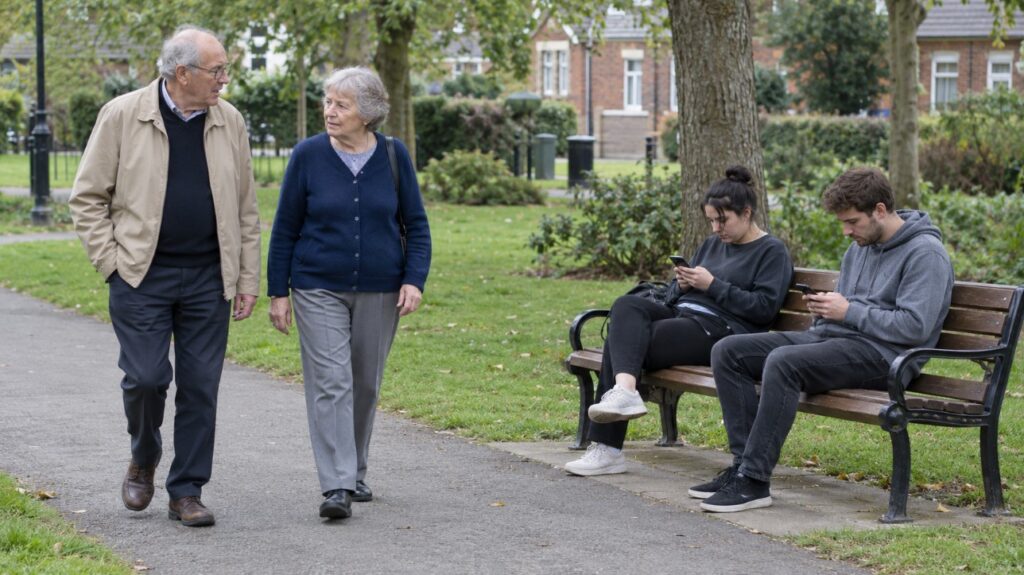
Older Americans are supposed to be slowing down. Gen Z is supposed to be young, mobile, and physically capable of crossing a parking lot without thinking much about it.
Walking data complicates that picture. An analysis of 7.7 million users worldwide, including 1.3 million Americans, found older adults logging about 15% more daily steps than Gen Z.
A larger 2025 analysis covering nearly 15 million walkers found young adults walking almost 13% less than middle-aged adults.
Numbers that large deserve attention. Explanations deserve more caution.
Smartphones are an obvious suspect. Younger adults now work, study, shop, socialize, apply for jobs, order food, watch entertainment, and manage much of daily life through screens.
Convenience removes movement quietly. Still, blaming the phone is easier than proving the phone caused the gap.
A Walking Gap Worth Taking Seriously
Two very large datasets produced essentially the same generational pattern.
WeWard analysis tracked 7.7 million users globally, including 1.3 million Americans, and found older adults averaging about 15% more daily steps than Gen Z.
A broader 2025 report looked at nearly 15 million walkers and again placed young adults at the bottom. Gen Z walked almost 13% less than middle-aged adults.
Such consistency makes random chance a less satisfying explanation. Size alone, though, does not make a dataset nationally representative.
Users were participating in a walking-rewards app. People who install an app built around movement may already differ compared with people who never track steps. Age groups may also engage with such apps differently.
Millions of observations can make a pattern statistically stable while leaving sampling questions unresolved. Large numbers do not repair every weakness in study design.
Still, dismissing the gap would be equally careless.
Something meaningful appears to be happening. Data simply cannot tell us yet what is causing it.
Screen Time Fits the Story Almost Too Well

Smartphones make an unusually convenient suspect because so many ordinary tasks now happen without physical movement.
Activities once associated with leaving home can now happen while sitting down:
- Grocery and restaurant orders can arrive at the door.
- Job applications and interviews can happen online.
- Banking, shopping, entertainment, and social interaction can all occur on one device.
- College coursework and many office jobs can be completed without a commute.
The shift is not only about movement. For some men, especially younger men, more social interaction now takes place through screens rather than in person. This raises another question: could a more screen-based daily life be making people lonelier while also reducing how much they move?
Still, plausible is not the same as proven.
Available evidence does not show that smartphones caused Gen Z’s lower step totals. Nor does it establish screen exposure as the dominant explanation.
A more useful question is what the screen replaces:
| Screen Activity | Likely Effect on Movement |
| 2 hours watching videos instead of walking around town | Clearly displaces physical activity |
| 2 hours using a phone while riding a train | May have little effect on step totals |
| 20 minutes arranging transportation | May help an older adult leave home and become more active |
National data offer some support for the concern, though not proof of cause.
Among 12- to 17-year-olds, 70.4% of those reporting no more than two hours of weekday screen time were physically active for at least 60 minutes on most days or every day. That figure fell to 54.4% among those reporting four hours or more.
Researchers studying sedentary behavior have run into a similar problem for years. Sitting at a desk for eight hours does not tell us how much someone exercises before work, after work, or during breaks.
Headline logic tends to flatten those differences, but evidence should not.
Work May Be Doing More Than We Think

Employment conditions give Gen Z another reason to spend long stretches sitting in front of screens.
Across 2024 and 2025, 36.3% of workers ages 25 to 34 did some work at home, while 30.9% had days spent working exclusively at home.
None of that proves lower activity. It does show how easily commuting and workplace movement can disappear for a sizable share of younger workers.
Job searching means hours of applications. Remote interviews remove travel. Online courses remove campus walking. Freelance and remote work can eliminate a commute entirely.
None of that looks dramatic on its own.
Daily routines, however, are built out of small repeated behaviors. Remove enough trips, hallways, errands, and commutes and step totals begin to change.
Retirement creates a different pattern.
Many older Americans are not spending every day at home.
Survey findings on retirees show considerable participation in paid work or interest in returning:
| Retiree Employment Status | Share |
| Retired Americans surveyed who were working paid jobs | 45% |
| Retirees open to returning to work | 19% |
| Retirees returning because they needed income to make ends meet | 33% |
Paid work often moves without anyone deliberately exercising.
Parking lots count. Hallways count. Trips to lunch count. Walking between rooms counts.
Step totals often rise through routine, not intention. Smartphones make a cleaner villain because everyone recognizes the image. Work schedules, economic pressure, and employment structure are less dramatic.
Less dramatic explanations often deserve more attention.
Older Adults Use Plenty of Screens Too
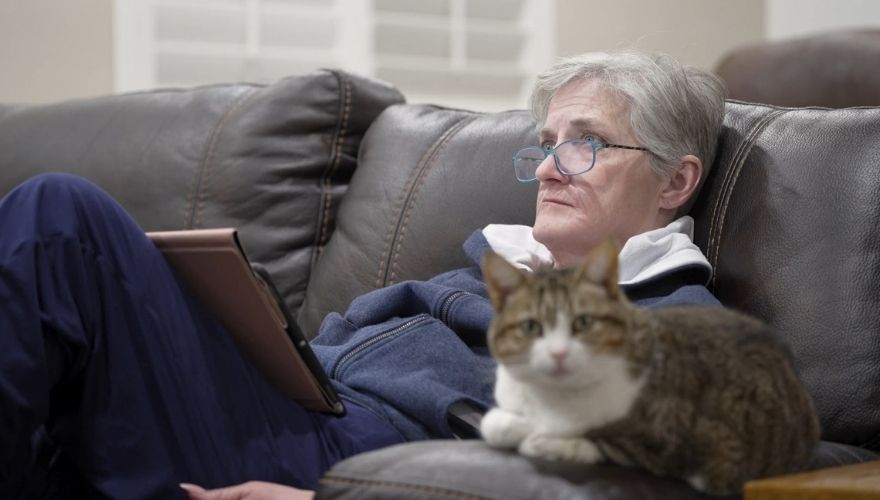
A simple “more screens, fewer steps” explanation has one obvious problem.
Older adults spend substantial time using screens.
People aged 60 and older were already spending more than half of their leisure time watching screens in 2019, mainly television and video.
Usage increased further during the pandemic era.
Social-media participation is also much higher among older adults than many people assume.
| Metric | Figure |
| Americans over age 50 using social media | 9 in 10 |
| Americans over age 50 using Facebook | 72% |
| Americans over age 50 using Instagram | 34% |
| Americans over age 50 using TikTok | 18% |
| Average social-media use among adults over 65 | 104 minutes per day |
AI tools are becoming part of older adults’ digital routines as well. About 23% of seniors use chatbots, rising to 42% among adults ages 50 to 64, according to Pew Research.
Such numbers make a purely technological explanation difficult to sustain.
Older adults can spend significant time using devices and still log more walking in large datasets.
Purpose may matter more than duration.
Someone can watch television for two hours after spending the morning running errands and walking through a shopping district. Someone else can use a phone for six hours because nearly every obligation now occurs digitally. Identical labels such as “screen time” hide very different days.
Technology can even help older adults move more.
Rideshare apps, for example, can help people who no longer drive reach stores, medical appointments, parks, restaurants, or friends.
In that case, a screen is not replacing movement. It is helping make movement possible.
Daily Life Shapes Walking More Than Motivation Alone
Walking is often discussed as though people simply decide how active they want to be.
Daily environments make that much less straightforward.
Income, transportation, neighborhood design, access to green space, employment, health, and safety all affect how much movement gets built into an ordinary day.
Where You Live Changes How Much You Walk

Large walking datasets found higher step totals associated with higher average income and longer life expectancy. Urbanization, transportation access, and green space also tracked with movement patterns.
Such associations need careful interpretation.
Higher income does not automatically cause more walking. Extra steps do not independently explain longer life expectancy. Multiple social and environmental factors overlap.
Consider two equally motivated people.
One lives near stores, transit, parks, and medical offices. Walking naturally enters the day.
Another lives in an area where every errand requires a car.
Step counts can differ sharply even when personal attitudes are nearly identical.
Age Changes the Daily Routine
Retirees may have greater control over their schedules and may deliberately walk for exercise. Younger adults can spend more time in remote work, online education, irregular employment, or long periods of job searching.
Health complicates the comparison in the opposite direction.
Older adults generally face more mobility limitations, joint problems, and chronic illness. Seeing older users still record more steps is therefore interesting.
Yet that result does not automatically mean older Americans as a whole are more active.
Millions of Users Still Do Not Eliminate Sampling Bias
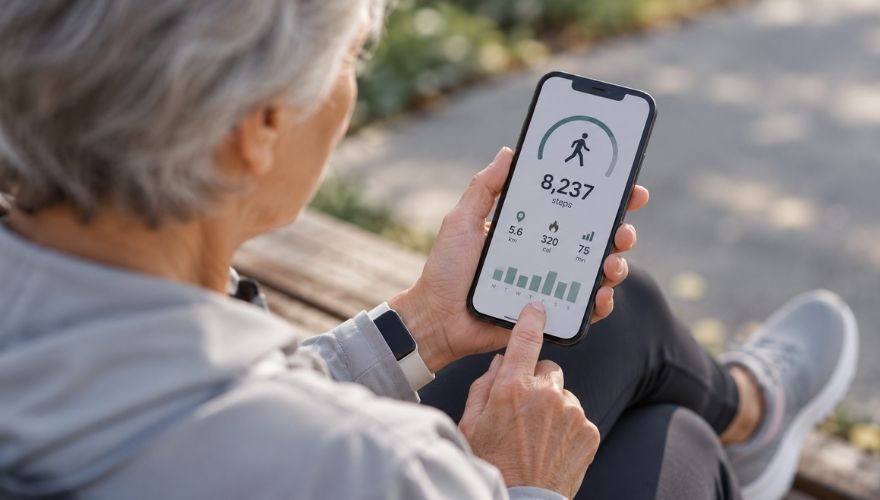
Older people willing to use a walking-rewards app may represent a particularly active subset of their age group.
Sampling bias does not disappear simply because the dataset contains millions of people.
A very large sample can make a pattern look impressively authoritative while still drawing on people who differ meaningfully compared with the broader population.
Study design still gets the final word.
Side Hustle Nation created a video testing “get paid to walk” apps to see how realistic their earning claims actually are.
Interesting Finding, Incomplete Explanation
Gen Z users walk less than older adults in two enormous datasets.
That conclusion looks fairly solid within the populations studied.
Screen-heavy living probably contributes.
Digital work can remove commuting. Delivery can remove errands. Streaming can replace outside entertainment. Online shopping can eliminate trips through stores. Remote communication can reduce travel. Modern life has become extremely efficient at removing incidental movement.
Motor vehicles accounted for 91% of passenger trips in 2022, while walking accounted for only 7%. Against that backdrop, relatively small changes in commuting, shopping, and entertainment routines can plausibly remove a meaningful share of daily steps.
Older adults use plenty of technology. Employment conditions differ sharply by age. Neighborhood design matters. Transportation matters. Income matters. Daily schedules matter.
One broader number may be more important than the generational comparison itself.
About 63% of Americans in the 2025 walking data logged fewer than 7,000 steps per day.
That suggests a much wider shift.
Cars remove walking. Delivery removes errands. Remote work removes commutes. Digital entertainment removes trips outside the home.
Convenience keeps getting better at accomplishing tasks without asking the body to participate.
Gen Z may simply be experiencing that version of modern life most completely.
Screens are probably part of the explanation. Evidence does not support treating them as the entire explanation.
Interesting finding, yes.
Solved case, no.