


Teenagers can find a workout almost instantly. TikTok is full of short routines. YouTube has endless training channels. Fitness apps can build programs in seconds. School weight rooms, sports programs, and online coaches add even more options.
So why has muscle-strengthening activity among US high school students moved downward over the past decade?
Federal surveillance defines muscle strengthening broadly. A student counts as meeting the benchmark after doing exercises to strengthen or tone muscles on at least three days during the previous week.
A CDC report that covers a decade, from 2013 to 2023, states the following:
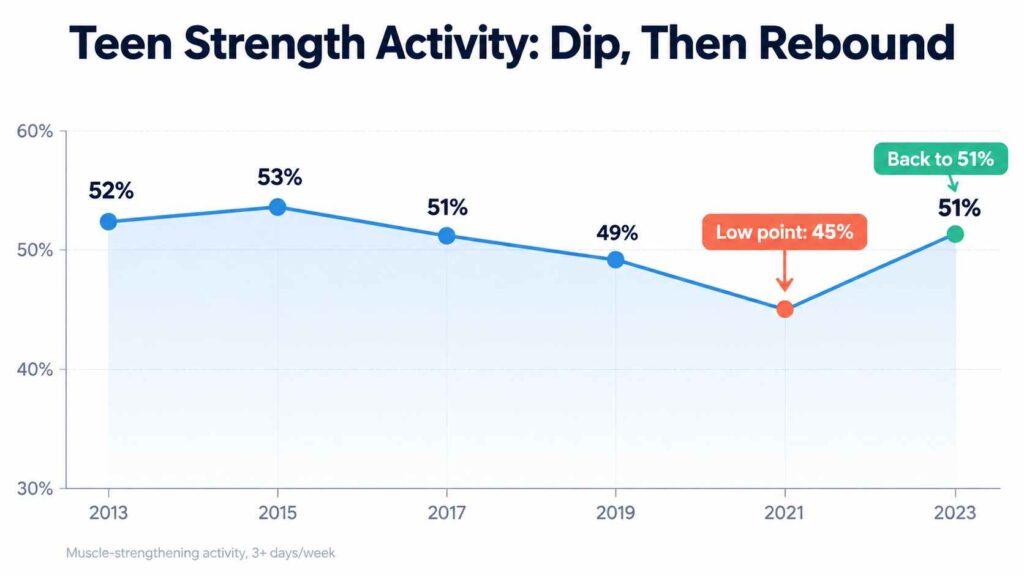
- 2013: 52%
- 2015: 53%
- 2017: 51%
- 2019: 49%
- 2021: 45%
- 2023: 51%
Still, anyone looking at that sequence should resist the dramatic headline.
Participation did not fall every survey year. It drifted lower after 2015, hit a decade low in 2021, then climbed six percentage points by 2023.
So are teenagers losing interest in strength work, or is muscle strengthening getting caught inside a much broader problem with physical activity?
Most Teenagers Are Missing Overall Activity Targets Too

Only about 25% of high school students in 2023 reported getting at least 60 minutes of physical activity every day. About 16% met both federal aerobic and muscle-strengthening recommendations.
That gap matters. A teenager can do push-ups, lift weights, or complete another muscle-strengthening activity three days a week and still spend too little time moving overall.
One four-year study that used accelerometers to measure activity found that only 9% of students consistently met recommended activity levels.
Activity also tended to fall as students moved through adolescence and into young adulthood.
Objective tracking is useful here because self-reported exercise has obvious limits. People forget. People estimate. People sometimes count activity generously. Accelerometers cannot explain motivation, but they can show how much movement is actually happening.
Once that broader context is visible, muscle strengthening stops looking like an isolated gym issue.
A One-Percentage-Point Gap Can Still Describe a Declining Trend
One skeptical reaction is obvious.
Participation was 52% in 2013 and 51% in 2023. Is a one-point difference really enough to support a story about decline?
Looking only at those endpoints makes the change look almost trivial. Trend analysis, however, uses the full sequence of survey years rather than treating 2013 and 2023 as the entire story.
Participation reached 53% in 2015, slipped to 51% in 2017, fell to 49% in 2019, then dropped to 45% in 2021. By 2023, it had recovered to 51%.
So two things can be true at once.
A declining trend was recorded across the 2013 to 2023 period. At the same time, the national percentage in 2023 sat only one point below its 2013 level.
That is exactly where interpretation matters.
Health statistics do not become unimportant simply because they fail to produce a dramatic chart. But modest changes should be described as modest changes. Treating a six-point pandemic-era dip as proof of a steady ten-year collapse would give readers a cleaner story than the data support.
Participation also improved sharply between 2021 and 2023. Any serious reading of the decade has to make room for that rebound.
Research here is worth paying attention to. A social-media version claiming teenagers abandoned strength training is another story.
Declines Look Very Different Across Student Groups
National averages can make unequal patterns look comfortably ordinary.
Sex differences are especially large.
In 2023, 64% of male students reported muscle-strengthening activity on at least three days a week. Among female students, the figure was 37%.
Female participation also dropped across the decade, moving between 42% in 2013 and 37% in 2023. Male students showed no significant ten-year change.
So the national decline is not a story about every teenager moving in the same direction.
Race and ethnicity show another uneven pattern. 10-year decreases were recorded among Black and Hispanic students, while most other racial and ethnic groups did not show a significant long-term change in muscle-strengthening participation.
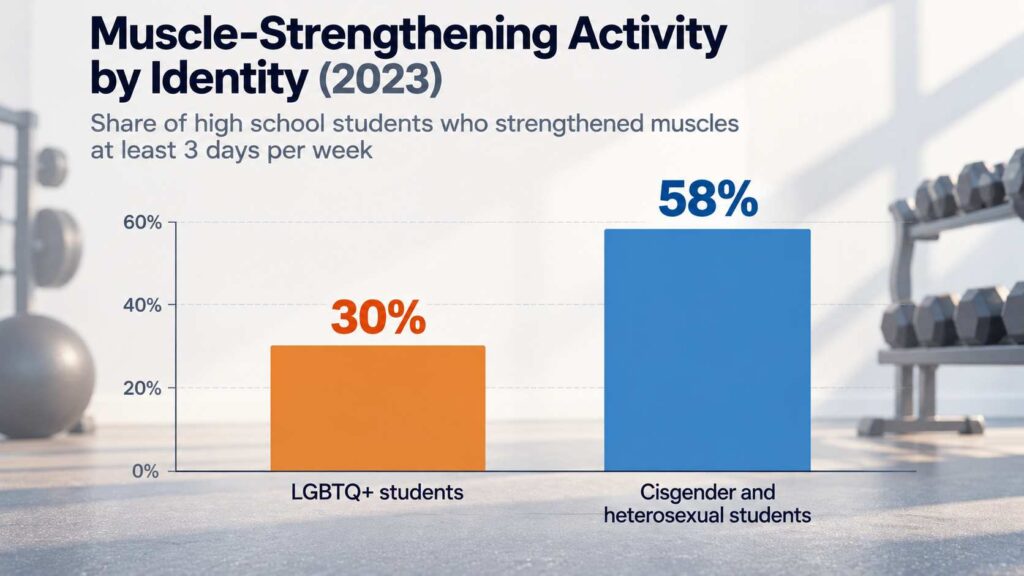
Differences tied to sexual and gender identity were even larger in 2023. About 30% of LGBTQ+ students reported strengthening muscles at least three days a week, compared with 58% of cisgender and heterosexual students.
Once those numbers are separated, saying teenagers simply need to exercise more starts sounding too convenient.
Participation differs by dozens of percentage points across some groups. Motivation may matter for an individual student, but gaps that large invite harder questions.
Who feels comfortable in school fitness spaces? Who has access to equipment, coaching, transportation, sports, or safe recreation? Who sees strength training as something meant for people like them?
Social participation deserves attention too. A separate Gallup-based analysis of loneliness among young American men found substantial differences between the U.S. and other wealthy countries.
A workout can be simple. Getting into a situation where doing it feels realistic may not be.
“Exercise More” Has Not Fixed Youth Inactivity
Public-health advice has spent years telling young people to move more.
Results have been stubborn.
Researchers studying adolescent physical activity have argued that youth inactivity stays high despite decades of programs meant to increase movement. Their point is practical: asking only if an intervention worked does not tell us enough.
Better questions sound more like these:
- Who actually benefited?
- Under what conditions did a program work?
- Which barriers blocked participation elsewhere?
- Did teenagers have any role in designing the program?
Activity does not happen in one controlled setting. It happens at school, on the way home, in sports, during recreation, around family schedules, and across local communities.
Practical barriers pile up quickly. Homework can consume afternoons. Phone and computer use can occupy large blocks of free time. Physical education may be limited. Parks, gyms, courts, and safe walking routes are not equally available. College plans, part-time work, transportation, and family responsibilities can squeeze schedules further.
“Exercise three times a week” sounds easy when written as a recommendation.
A teenager still needs time, a place to do it, enough confidence to begin, some idea of what to do, and preferably an environment that does not make exercise feel awkward or miserable.
Advice is easy to type. Daily life decides how practical it is.
Schools May Matter More Than Fitness Culture
Commercial fitness gets enormous attention, but teenagers spend much of their weekday life in school.
That makes school-based opportunity difficult to ignore.
Pandemic-era data were much lower. Daily PE participation reached only 19% in 2021 before climbing back to 27% in 2023.
Sports-team participation also decreased across the 2013 to 2023 period.
None of that means PE alone can fix youth inactivity. School schedules are crowded, sports do not interest everyone, and a badly designed gym class can convince a teenager that exercise is something to avoid.
Still, schools can create opportunities that do not depend on gym memberships, family transportation, or a teenager discovering a fitness creator online.
Useful approaches can include more chances to move before school, during the day, and after classes. Programs also work better when students feel safe, included, and heard when barriers are identified.
Closing Thoughts
Muscle-strengthening participation among US high school students showed a declining trend across 2013 to 2023, but the national change was modest when comparing the beginning and end of the period. Participation also rebounded sharply after reaching 45% in 2021.
Bigger differences appear once the national average is broken apart. Female students saw a long-term decline, while male students did not show a significant ten-year change. Black and Hispanic students also recorded decreases.
Those gaps make the motivation-only explanation hard to defend.
Strength training declined over the decade, but not evenly, not dramatically, and not permanently.