



Some medical headlines weaken the moment you inspect the number underneath them. This one does not.
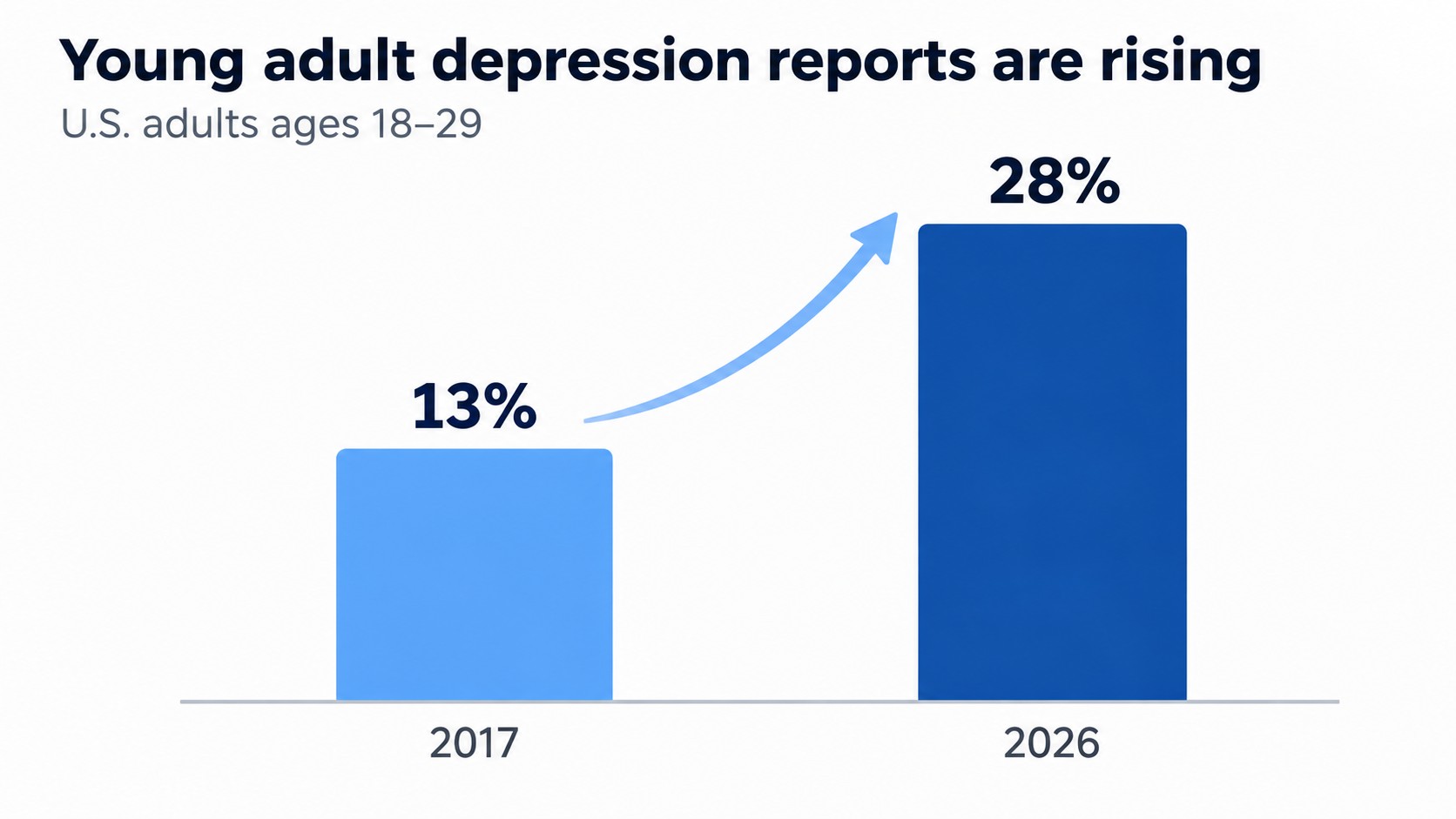
Gallup reports that 28% of Americans ages 18 to 29 now say they currently have depression or are being treated for it. In late 2017, that figure was 13%.
A rise of 15 percentage points in less than a decade is not statistical decoration. It is large enough to demand attention.
Still, one distinction matters immediately. Gallup did not sit 5,017 Americans in examination rooms and clinically assess them for major depressive disorder. Its measure relies on people reporting that they currently have depression or are receiving treatment.
So the headline is slightly more certain than the survey itself.
That caveat matters. It just does not make the underlying trend disappear.
Headline Number Is Not an Isolated One
Across all U.S. adults, 19.1% now report current depression or treatment, equal to an estimated 51 million people. That sits close to the 20% record reached in late 2025.
Lifetime diagnosis has climbed as well. Some 29.5% of adults now say a doctor or nurse has told them at some point that they had depression. In 2015, 19.6% said the same.
One number could be survey noise. Several measures moving in the same direction are harder to shrug off.
Current depression, lifetime diagnosis, treatment use, loneliness, and self-rated emotional wellbeing are not measuring precisely the same thing. That is actually useful. If each measure were identical, they would tell us less than they appear to.
Instead, separate indicators are arriving at a similar conclusion: Americans are reporting considerably more mental-health trouble than they did a decade ago.
Precision still matters. Saying 28% of young adults meet formal diagnostic criteria would go further than the evidence allows.
Saying the increase is probably meaningless would go further still.
Gen Z Is Too Easy an Explanation

Young people make convenient targets whenever a troubling social statistic appears.
Smartphones get blamed. Social media gets blamed. Parenting gets blamed. Gen Z itself gets blamed.
Adults now ages 27 to 38 report a depression rate of 24.6%. A comparable young-adult group registered 13% in 2017.
In other words, elevated depression did not vanish once that earlier group aged out of its early 20s.
That does not clear modern technology, economic pressure, social change, or generational habits of any role. It does mean a simple “Gen Z problem” explanation has poor footing.
People who were young adults several years ago also worsened.
We would be cautious about any argument that treats today’s 20-somethings as unusually fragile while ignoring similar deterioration among people now entering their 30s.
Data rarely cooperate with cultural stereotypes quite as neatly as commentary does.
COVID Fits the Timeline, but Not the Whole Story
Pandemic-era mental health deserves a place in the explanation.
Depression increased sharply between 2019 and 2023, reaching 19.2% among U.S. adults. Rates then eased to about 17.4% in mid-2024.
Had they continued downward, one could make a cleaner case that the increase was largely a temporary pandemic effect.
They did not.
Rates climbed again after the acute pandemic period, approaching their previous record.
A gap in Gallup’s data also deserves attention. No comparable measure was collected in 2021 or 2022, so there is no uninterrupted line showing exactly how prevalence changed through the middle of the pandemic.
That limitation should make anyone wary of overly precise narratives.
Still, chronology creates a problem for the simplest COVID explanation. Major restrictions ended. Schools reopened. Work routines stabilized, at least compared with 2020. Everyday social life returned in large part.
Money and Isolation Sit Close to the Problem
Income produces one of the sharpest splits in Gallup’s results.
Among adults in households earning less than $24,000 per year, 37.4% report current depression or treatment. Back in 2017, that figure was 22.1%.
Age complicates the comparison because younger adults are more likely to have low household incomes. Some 13% of young adults fall into low-income households, compared with 7% of adults 50 and older.
Financial pressure and age therefore overlap.
Rent, unstable employment, debt, limited savings, medical costs, and delayed independence can pile onto one another. None needs to be declared the cause of depression for the association to matter.
Loneliness shows an equally stark split.
Around one in five U.S. adults now report significant daily loneliness. Depression rates differ sharply depending on that experience:
- 33% of adults who experienced significant loneliness during the previous day reported depression.
- 13% of adults who did not report significant loneliness also reported depression.
A 20-point gap deserves attention.
Other national data suggest that social disconnection among younger adults is hardly a marginal problem. CDC researchers found loneliness among 43.3% of adults ages 18 to 34 in 2022, while 29.7% reported lacking social and emotional support.
Better Recognition Explains Something, Not Everything
Some 24% of adults report seeing a mental-health professional during the past year. In 2001, that figure was 10%.
Greater treatment use almost certainly raises reported prevalence. More people are screened. More people receive diagnoses. More people recognize symptoms. More people are willing to say so.
Attitudes toward primary care have changed too. About 70% of adults now say they want doctors to ask about mental health alongside physical health.
Any comparison stretching across decades has to account for that.
A person in 2001 might have experienced depression without naming it, reporting it, or ever receiving a diagnosis. A comparable person today has a better chance of entering the medical system.
Recognition can therefore explain part of the increase.
Problem solved? Not quite.
Depression Does Not Always Arrive Looking Like Sadness
Public discussion still tends to picture depression as visible misery.
Clinical reality is broader and often less obvious.
Someone can show up for work, answer messages, cook dinner, make jokes, and still experience symptoms that interfere substantially with daily life.
Less obvious signs can include:
- Loss of interest or pleasure in activities that used to matter
- Trouble concentrating, organizing thoughts, or remembering details
- Persistent irritability or unusual anger
- Recurrent thoughts about death
- Physical pain without a clear explanation or a reduced tolerance for pain
None of those symptoms proves depression on its own.
Poor sleep can damage concentration. Chronic stress can make people irritable. Pain has many causes. Grief can reduce interest in activities. Burnout can resemble depression in several ways.
What Gallup Can Tell Us, and Where It Has to Stop
Gallup surveyed 5,017 U.S. adults between February 18 and March 3, 2026 using its probability-based panel.
Sample size is not the main reason these results deserve attention. Comparability over time matters more.
Gallup has tracked related measures for years, allowing changes to be viewed against an earlier baseline rather than as a single dramatic snapshot.
Several conclusions look fairly solid.
Reported current depression or treatment has increased substantially. Younger adults have experienced an especially sharp rise. Low-income Americans report very high rates. Loneliness is strongly associated with depression. Mental-health treatment has become far more common.
Other conclusions are much less secure.
Data do not establish that 28% of adults ages 18 to 29 currently meet formal diagnostic criteria for major depressive disorder.
They do not identify one cause.
They cannot tell us exactly how much of the increase comes down to economic stress, loneliness, diagnostic awareness, treatment access, technology, housing pressure, pandemic effects, changing social habits, or some combination of all of them.
That uncertainty is not a flaw to be hidden. It is part of the result.