



You might expect a 22-year-old scrolling TikTok to spend more time staring at screens than their grandparents. Surprisingly, research suggests the opposite.
Americans ages 65 and older spent nearly 10 hours a day with televisions, computers, and smartphones, compared with approximately seven hours among adults ages 18 to 34, according to Nielsen data discussed in 2019 quoted by Economist.
That’s a difference of almost three hours daily, which is difficult to ignore when younger generations receive most of the criticism for excessive screen use.
But there’s an important catch. Older Americans spend much more time watching television, and some of that viewing happens while they’re doing other things.
Comparing the average screen time by age reveals some surprising generational habits.
But figuring out what those numbers actually say about someone’s health is considerably more complicated.
What Is the Average Screen Time by Age?
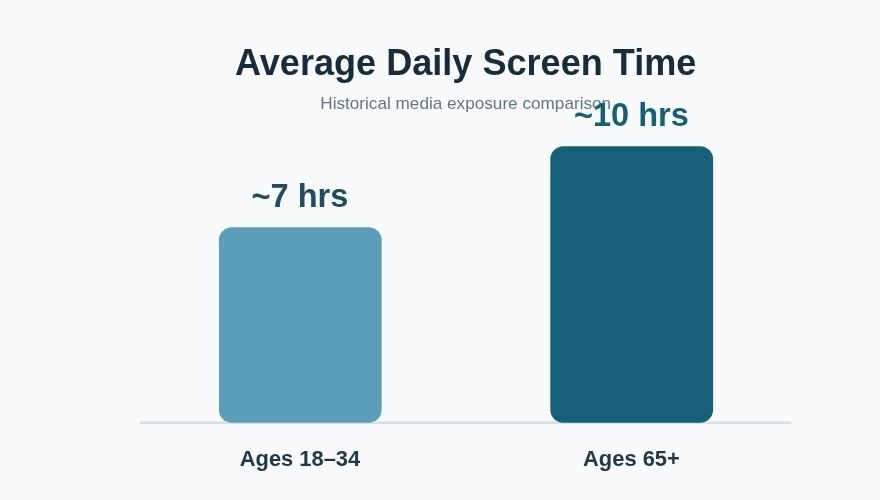
Average screen time by age varies significantly, with older Americans recording substantially more total media exposure than younger adults in the historical Nielsen comparison.
Reporting published in 2019 identified a considerable difference between adults ages 18 to 34 and those 65 and older.
Older Americans recorded approximately 43% more daily screen exposure than younger adults, based on the rounded figures.
Interestingly, smartphones weren’t responsible for the difference.
Younger adults spent approximately 3.5 hours daily using smartphones, compared with around two hours among seniors. Older Americans made up that difference, and considerably more, through television.
An important distinction concerns how screen time gets measured.
Media measurement can include television playing in the background and usage across multiple devices. Someone watching television while checking a phone can generate overlapping media exposure.
Time-diary research works differently. Participants identify their primary activity during specific periods, producing a clearer picture of how they allocate their day.
Consequently, two credible studies can produce dramatically different screen-time estimates without either being incorrect.
Anyone comparing average screen time by age should check the measurement method before concluding generational behavior.
Why Do Americans Over 65 Spend More Time on Screens?
Older Americans’ higher screen time isn’t simply a matter of watching more television out of habit.
Retirement, daily routines, and growing technology adoption all help explain the difference.
Comparing a retiree’s screen use with that of someone working full-time also raises an important question: How much of the gap comes down to having more free time?
Three factors help explain why adults over 65 spend more hours with screens.
Television Accounts for Most of the Difference

Older adults in the Nielsen findings averaged more than 7 hours daily with their televisions switched on, according to Statista.
Television viewing explains much of the difference in average screen time by age. Older Americans spend considerably more time with their TVs switched on, while younger adults concentrate more of their screen use on smartphones.
Younger adults spend roughly four hours less with television, making traditional viewing the biggest contributor to the generational difference.
Yet having a television on doesn’t necessarily mean someone is watching attentively.
Consider a retired adult who switches on the morning news, prepares breakfast, handles household chores, and occasionally checks the broadcast.
Several hours of television exposure could accumulate even though much of that time involves other activities.
That distinction matters because passive background exposure and concentrated viewing aren’t necessarily equivalent behaviors.
Smartphone use introduces a different complication. Someone checking messages repeatedly throughout the day might accumulate fewer hours but experience more frequent interruptions.
Neither habit can be judged accurately using total hours alone.
Retirement Changes How People Spend Their Day
Approximately 75% of older adults included in the Nielsen findings were retired.
That provides an important explanation for their greater screen exposure.
A 70-year-old retiree and a 28-year-old working full-time don’t have comparable daily schedules.
One person may have several hours available for television, hobbies, and social activities. Another spends much of the day working, commuting, and completing household responsibilities.
Retirement creates additional opportunities for leisure, and television is an accessible way to fill that time.
However, older adults shouldn’t be treated as a single group. Employment, caregiving responsibilities, health, and personal interests all affect daily routines.
Older Adults Are Increasingly Comfortable With Technology

Older Americans aren’t relying exclusively on television.
Research published in 2019 found that internet adoption among Americans 65 and older had increased substantially.
In 2000, only 14% used the internet. By 2019, that figure had reached 73%, while smartphone ownership stood at 53%.
Those numbers challenge the familiar assumption that seniors generally avoid newer technology.
Many older adults use smartphones to communicate, manage appointments, access news, and participate in activities that once required leaving home.
Consequently, greater technology use isn’t automatically evidence of an unhealthy habit.
Screen Time Among Older Americans Has Been Increasing
Longer-term research provides another way to examine the issue.
Pew research quotes a 2019 analysis of American Time Use Survey data found that adults ages 60 and older spent an average of four hours and 16 minutes daily on leisure screen activities.
That represented an increase of nearly 30 minutes compared with approximately a decade earlier.
Screens accounted for more than half of their daily leisure time, most of it involving television or videos. Meanwhile, time devoted to activities such as reading and socializing had declined slightly.
Research also found that older Americans averaged approximately seven hours of daily leisure, meaning screens occupied a substantial portion of their recreational time.
Pew’s analysis examined time diaries collected during 2003-2006 and 2014-2017, rather than measuring behavior directly in 2019.
Its four-hour figure is much lower than Nielsen’s nearly 10-hour estimate because the research methods differ.
Comparing the average screen time by age across different studies can therefore be misleading. A figure based on primary leisure activities measures something different than one that includes television exposure throughout the day.
Pew measured primary leisure activities, while Nielsen’s broader media figures could capture television exposure alongside other activities.
Another useful detail concerns education.
Among adults 60 and older, those with a high school diploma or less spent approximately 12 minutes daily exercising, compared with 26 minutes among college graduates.
That difference doesn’t establish that television caused lower exercise participation.
However, it raises an important question about how leisure opportunities, employment, education, and activity habits interact.
Does More Screen Time Mean Older Adults Are Addicted to Technology?

Some headlines about older Americans’ technology habits have suggested that seniors might be more addicted to screens than millennials or Gen Z. It’s an attention-grabbing comparison, but the evidence doesn’t justify that conclusion.
Spending 10 hours around screens isn’t sufficient to establish technology addiction.
Problematic use involves factors such as difficulty controlling behavior, continued use despite harmful consequences, and interference with everyday responsibilities.
A person who enjoys several hours of television may have no difficulty switching it off when something important comes up.
Another person might spend less time online but repeatedly interrupt conversations, lose sleep, or struggle to stop checking notifications.
Total screen time cannot reliably distinguish those situations.
Television also provides entertainment, news, relaxation, and sometimes a sense of companionship, particularly for people who spend substantial time at home.
None of that means excessive viewing is harmless. It simply means the consequences deserve more attention than the number displayed on a screen-time report.
Calling older adults the most technology-addicted generation makes for a provocative headline. Actual behavior is considerably harder to reduce to a competition.
When Does Screen Time Become a Health Concern?
Average screen time by age tells us how screen habits differ between generations, but it doesn’t establish which group faces greater health risks.
For that, researchers need to examine the activities involved and what people sacrifice to spend more time with screens.
What Screen Time Replaces Matters More Than the Total

Excessive screen use becomes more concerning when it consistently displaces physical activity, sleep, or meaningful social interaction.
Sleep, social connection, and emotional well-being are also important parts of the broader conversation about health. For a closer look at another aspect of young adults’ well-being, see our article on depression rates among Americans ages 18 to 29.
Prolonged sedentary behavior deserves particular attention.
Public-health guidance identifies excessive sitting as a health concern, with higher sedentary time associated with increased risks of cardiovascular disease, type 2 diabetes, and premature death.
Replacing sedentary time with physical activity, including light movement, can provide health benefits.
But screen time and sedentary time aren’t interchangeable.
Someone following an online exercise class is using a screen while staying physically active. Another person could spend several hours reading printed books while sitting almost continuously.
Judging health solely by device use misses that distinction.
For adults 65 and older, CDC recommendations call for at least 150 minutes of moderate-intensity aerobic activity weekly, or 75 minutes of vigorous activity, alongside muscle-strengthening exercises at least twice weekly and activities that improve balance.
Those recommendations give people a more useful benchmark than an arbitrary daily television limit.
Not All Screen Activities Have the Same Impact
Imagine two retired adults who each spend four hours daily using screens.
One watches television continuously while sitting on the couch. Another spends an hour video calling family, follows a 30-minute exercise class, reads online, and watches a movie.
Their total screen time is identical, but their activities have different physical and social characteristics.
That’s why recommendations to cut screen time can become unnecessarily simplistic.
Research into sedentary behavior examines the consequences of inactivity, while studies of social connections and technology use address different questions.
Screen-based activities can support learning, communication, and participation in everyday life.
Potential problems arise when certain habits become difficult to control or consistently push aside activities important for physical and emotional well-being.
Rather than treating screens as the problem, examining what happens during those hours produces more useful answers.
Closing Thoughts
Average screen time by age reveals an unexpected pattern: Historical research found that Americans over 65 spent considerably more time with screens than younger adults, largely because of television rather than smartphones.
But screen exposure, active device use, and recreational viewing measure different habits. Treating their totals as interchangeable can produce misleading conclusions.
For older adults, the most useful question isn’t how their screen time compares with someone half their age.
It’s how those hours fit into daily life.
Watching a favorite program isn’t automatically a problem. Consistently sacrificing physical activity, sleep, or social connections to keep watching deserves more attention.
Ultimately, what people do with their time matters more than which generation wins an argument about screens.