

Anyone who has spent much time around adolescents knows that sleep has rarely been their strongest habit. Late homework, early classes, jobs, sports, friends, loneliness, and simple resistance to bedtime all predate smartphones by decades.
What has changed is the scale of the numbers.
University of Minnesota surveyed 18- and 19-year-olds from 2021 through 2023 and found that only 22% reported getting at least seven hours of sleep on most nights. Among 12- and 13-year-olds, just 37% reported the same. Every age group measured had reached its lowest level across more than three decades of survey data.
Those figures deserve attention, although I would hesitate to turn them into another declaration of a newly discovered teenage health crisis. Adolescents sleeping too little is not new. Pediatricians have worried about it for years.
What looks more consequential is the persistence of the decline. Reported sleep did not simply dip during one bad year or one particularly stressful school cycle. It moved downward over a long period and ended at its lowest point in the most recent survey years.
That is harder to wave away. For now, a more defensible conclusion is also a less dramatic one: an old adolescent sleep problem appears to have become considerably worse.
What Researchers Actually Measured
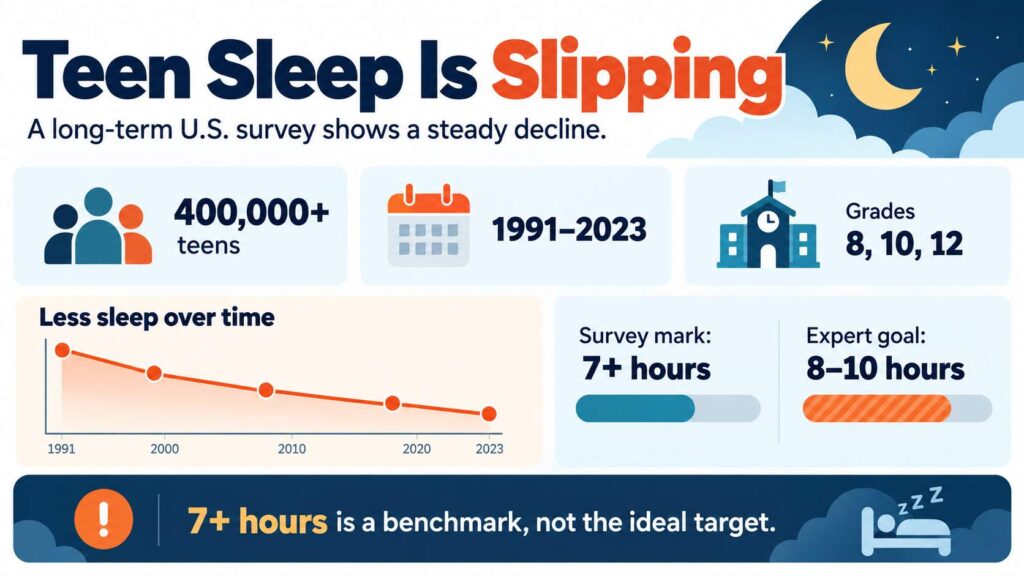
Researchers analyzed responses involving more than 400,000 U.S. adolescents participating in the long-running Monitoring the Future survey.
Students in 8th, 10th, and 12th grades were included, with observations covering 1991 through 2023. Two measures were central to the analysis. Adolescents reported how often they obtained at least seven hours of sleep and how often they felt they were getting enough sleep.
Across the age groups studied, sleep declined. Older adolescents consistently reported less sleep than younger adolescents, and feelings of getting enough sleep also became less common with age.
Seven hours needs context.
American Academy of Sleep Medicine guidance recommends 8 to 10 hours of sleep per 24 hours for teenagers, a recommendation endorsed by the American Academy of Pediatrics. Crossing the seven-hour mark, then, should not be mistaken for meeting the clinical recommendation.
A teenager reporting seven hours has cleared the study’s measurement threshold. That does not necessarily mean the teenager is sleeping enough. Such distinctions can look fussy until a headline turns “at least seven hours” into “adequate sleep.” Those are not quite the same claim.
A Convincing Trend Does Not Make Every Detail Precise
Several aspects of the research deserve considerable weight.
More than 400,000 adolescents create a very large evidence base. National representation helps, and three decades of repeated observations are far more informative than a one-year snapshot. Long-term consistency is especially useful here. A single survey can capture an unusual moment. A pattern extending across many years is harder to dismiss as statistical weather.
Measurement quality still matters.
Sleep was self-reported rather than recorded objectively through wearable devices, laboratory testing, or other direct methods. Asking someone how often they sleep at least seven hours cannot provide the precision of measuring nightly duration.
Perceptions of getting enough sleep are even more subjective. One adolescent may regard six and a half hours as normal because that is what he or she has grown accustomed to. Another may sleep longer and still feel tired.
Observational research adds another limitation. It can show that sleep changed and that certain characteristics were associated with better or worse sleep. It cannot, on its own, tell us exactly why those changes occurred.
Long-running surveys are excellent at showing direction. They are considerably less talented at supplying a culprit.
That does not make the decline unimportant. It simply means readers should separate confidence in the trend itself from confidence in explanations attached to it.
Smartphones Fit the Story Better Than They Prove It
Messaging, video, games, schoolwork, social media, news, and peer interaction can all continue well past bedtime. Few earlier generations carried quite so many reasons to stay awake in a device placed beside the pillow.
Still, plausibility should not be mistaken for proof.
Researchers did not establish that smartphones or social media caused the decline. Rising screen use overlaps with part of the downward movement, but overlap alone cannot tell us how much responsibility belongs to phones.
Older pressures deserve remembering.
Homework, extracurricular activities, part-time jobs, late socializing, and early school schedules were interfering with adolescent sleep well before short-form video and constant notifications arrived.
Newer pressures have been added on top. Smartphones, social media, pandemic-era disruption, and broader social stress now compete for the same limited evening hours.
Screens make a satisfying explanation because almost everyone can picture the teenager scrolling at midnight. Evidence is less tidy.
Teenagers were already losing sleep before TikTok existed, and research not designed to establish causation cannot tell us how much of the decline belongs to any single technology.
However, Pew Research Center found that 68% of U.S. teens ages 13 to 17 used TikTok in 2025, while 21% described their use as almost constant.
They do not establish that TikTok caused the decline in sleep, which is precisely where an intuitive explanation can outrun the evidence.
Sleep Gaps May Be More Important Than the Average
Overall decline gets attention first, but disparities inside the data may tell us more about what is actually happening.
Black and Hispanic or Latino adolescents experienced larger declines over time. From 2021 through 2023, both groups were less likely than white adolescents to report at least seven hours of sleep.
Parental education was associated with sleep as well.
Adolescents whose parents had higher levels of education were more likely to report sufficient sleep. During 2021 through 2023, having a parent with a college degree was associated with 57% greater odds of reporting at least seven hours.
Female adolescents also consistently reported lower rates of adequate sleep than male adolescents.
Patterns like these make simple advice about bedtime discipline look incomplete.
Lower household income was associated with shorter sleep and greater schedule disruption. Such patterns do not identify a single cause, but they make sleep look considerably less like a simple bedtime decision.
School timing, parental work schedules, household stress, neighborhood conditions, employment, caregiving duties, and socioeconomic resources can all affect how much opportunity an adolescent has to sleep.
None of those mechanisms were proven by the study. Treating them as established causes would repeat the same mistake made with smartphones.
Still, social differences of this size make a purely individual explanation difficult to sustain.
Bedtime may be an individual act. Opportunity to sleep is not distributed entirely by individual choice.
Advice to put away a phone or go to bed earlier can still be sensible. It just does not explain why sleep loss follows social and demographic patterns so consistently.
Older Teenagers Look Particularly Vulnerable
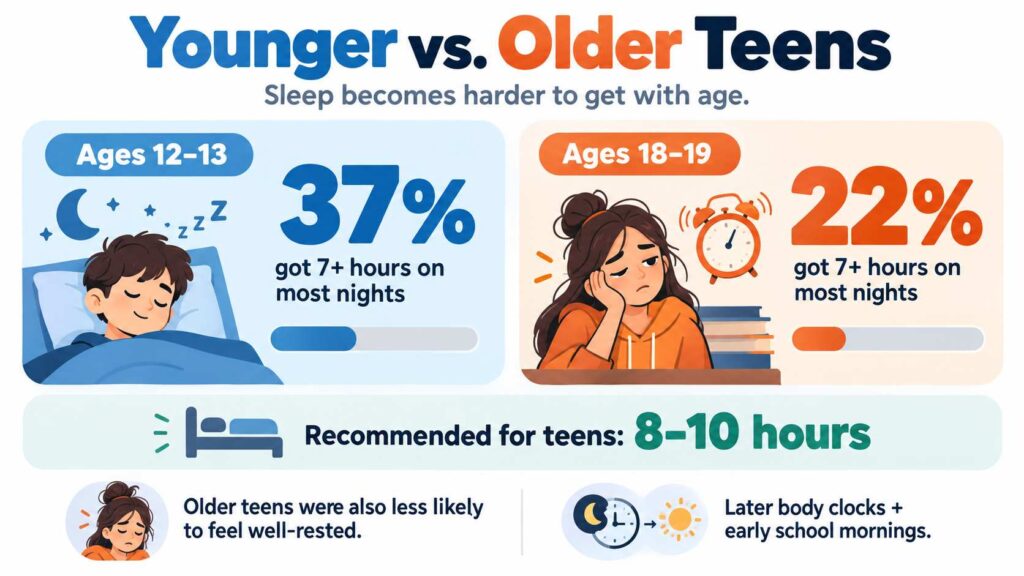
Age produced one of the clearest patterns.
Reported sleep decreased as adolescents grew older. During 2021 through 2023, only about 22% of 18- and 19-year-olds said they obtained seven or more hours on most nights.
Younger adolescents did better only by comparison. About 37% of 12- and 13-year-olds reached the same threshold.
Neither number looks reassuring beside a clinical recommendation of eight to 10 hours.
Older adolescents also became less likely to report feeling that they were getting enough sleep.
Biology complicates the picture.
Adolescent circadian rhythms tend to shift later, which can make earlier sleep onset difficult. School schedules often continue to demand early waking anyway.
School timing is one area where researchers have evidence stronger than simple correlation.
In a cohort of 455 high school students whose sleep was measured with wrist devices, schools delaying their morning start by 50 or 65 minutes saw students gain roughly 41 to 43 minutes of sleep on school nights compared with students attending schools that kept early schedules.
A teenager who does not become sleepy until late in the evening but must be awake early for class is not dealing solely with poor planning.
Why Short Sleep Matters
Insufficient adolescent sleep has been associated with daytime fatigue, impaired functioning, poorer executive function, academic difficulty, mental-health problems, injury risk, chronic-disease risk factors, and later health concerns.
Other research has also associated longer sleep with stronger performance on cognitive testing.
Such findings matter clinically. Causal language still requires restraint.
Academic performance offers a useful example of why restraint matters. A systematic review of U.S. adolescents found essentially no statistically significant overall relationship between sleep duration and academic performance, while sleep quality showed only a small association.
Sleep may still matter greatly for an individual student, but population-level evidence does not support treating every lost hour as a predictable drop in grades.
Sleep has an awkward role in health research because it can influence well-being while also responding to it.
Anxiety can interfere with sleep. Poor sleep may worsen anxiety.
Academic pressure can keep an adolescent awake. Exhaustion can then make schoolwork harder the next day.
Mental health, physical health, family stress, school demands, and sleep can reinforce one another in ways that are difficult to separate cleanly.
Anyone claiming that insufficient sleep single-handedly produces every associated problem is offering more certainty than the evidence supports.
Dismissing sleep as merely a symptom would go too far in the opposite direction.
No dramatic claim is needed to make that medically relevant.
An Old Problem Has Become Harder to Dismiss
Concern about adolescent sleep long predates smartphones, social media, and current arguments over screen time.
Recent data do not reveal a newly invented disorder. They show that a familiar problem has continued to worsen.
From 2021 through 2023, reported sleep had fallen to its lowest levels across more than 30 years of observations. Older teenagers reported especially little sleep, and important demographic gaps had widened.
Disparities also make it difficult to treat adolescent sleep solely as a matter of personal lifestyle.
Evidence cannot yet assign each factor a neat percentage of responsibility. Medicine rarely offers that sort of accounting.
What can be said with greater confidence is less sensational and probably more useful.
Physicians, parents, and schools have known for decades that teenagers often sleep too little. More than 30 years of survey data now suggest that knowing about the problem has not translated into much success in correcting it.